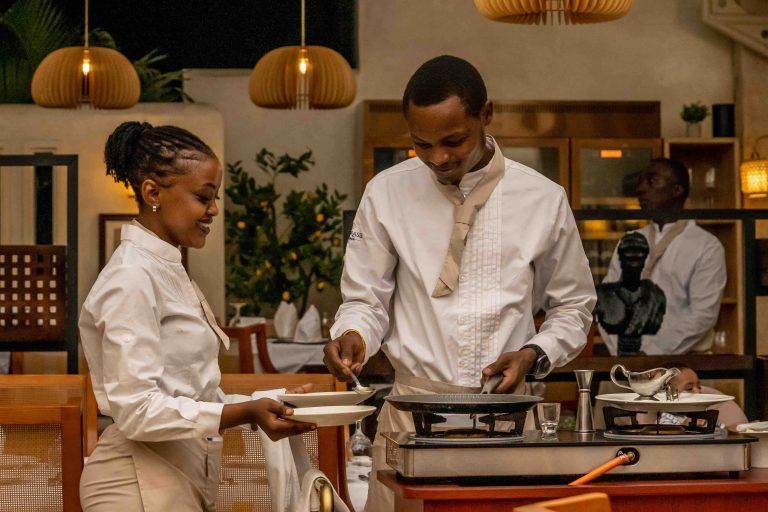
Crêpe Suzette possesses the elegance of those desserts whose very name instantly evokes a scene: a frying pan, the fragrance of orange, and a brief blue flame. That image is accurate, but incomplete. Suzette is first and foremost a composition of crêpes and citrus butter; flambéing, which has become its most spectacular hallmark, neither fully defines it nor tells its entire story.
Balanced between a codified recipe, a late memoir, and restaurant service traditions, its history invites us to distinguish established facts from the stories that helped make it famous. This takes nothing away from its charm. On the contrary, the legend becomes even richer once we understand where it belongs.
What Is a Crêpe Suzette? Defining the Dessert Without Reducing It to the Flame
A crêpe Suzette is a very thin, supple, delicate crêpe coated in beurre Suzette (Suzette butter). Traditionally, this preparation combines butter, sugar, citrus zest, and the juice of oranges or mandarins. The exact proportions, as well as the choice of citrus fruits, vary from one establishment to another and have evolved over time.
The crêpes are folded—most often into quarters—and gently reheated in the scented butter. They should absorb the sauce without falling apart. Over controlled heat, the sugar melts, the juices reduce slightly, and the mixture develops a glossy finish. This glaze gives the dessert its distinctive texture: a warm, satiny crêpe that is buttery, fresh, and delicately caramelized.
Some versions include alcohol, particularly Curaçao or Grand Marnier. It may be incorporated into the sauce, reduced during cooking, or flambéed at the table. However, alcohol alone does not define a Suzette. A citrus crêpe that has been flambéed is not automatically a Suzette; conversely, a genuine Suzette may be served without any flame at all.
Escoffier’s Recipe: A Landmark in Culinary History
The principal documentary reference is the publication of Auguste Escoffier’s Guide Culinaire in 1903. The book includes a recipe for “crêpes Suzette,” thereby establishing, in one of the foundational works of French cuisine, the existence of a preparation that was already named and clearly recognizable.
The recipe calls for thin crêpes prepared with—or filled with—a flavored butter made from butter, sugar, and citrus, then heated until glazed. It clearly defines the essence of the dessert: the union of a light crêpe with aromatic butter, enhanced by the acidity of citrus zest and juice.
One point deserves to be stated without ambiguity: Escoffier’s recipe does not prescribe flambéing. The version codified in 1903 therefore does not present the flame as an essential component of the dessert. This does not allow us to date with certainty the emergence of flambéing practices associated with Suzette, but it does establish a crucial distinction between the historical recipe and the image that later came to dominate.
That said, Escoffier should not necessarily be regarded as the dessert’s sole inventor in the absolute sense. A cookbook records and organizes a recipe; it does not always recount every stage of its earlier development, adaptation, or circulation through restaurants. His recipe remains a decisive milestone—not a complete birth certificate.
Where Did the Legend of the Flame Come From?
The best-known story is that of Henri Charpentier. In his memoirs, he recounts that while working in Monte Carlo, he accidentally set fire to a crêpe preparation intended for the Prince of Wales, the future King Edward VII. The prince reportedly enjoyed the result. Charpentier initially suggested naming the dessert after his distinguished guest, but the prince instead asked him to choose the first name of a young woman seated at the table: Suzette.
The anecdote is masterfully constructed. It contains all the elements of a memorable story: a fortunate accident, a royal patron, the pressure of table service, and the inspired naming of a dish. At a single stroke, it explains both the flambéing and the dessert’s fame.
Yet it should be read for what it is: a memoir written decades after the events it describes. Charpentier published the account nearly forty years after the incident, which he dated to the mid-1890s. His testimony is valuable because it reveals how a professional chef later narrated his own career and how Suzette came to occupy a place in gastronomic memory. By itself, however, it does not constitute conclusive proof of invention.
Moreover, Escoffier’s published recipe already attests to the dessert without prescribing flambéing. Between the alleged episode, the printed recipe, and restaurant practice, there remain gaps that the available historical evidence cannot fully bridge. Historical caution does not require dismissing Charpentier’s story; it simply advises against treating it as unquestionable fact