Beef Wellington’s connection to the Duke of Wellington is often repeated but not definitively documented. Discover its layered British and French influences, the role of duxelles and the practical details behind this enduring celebratory dish.
The story
Beef Wellington: The Story Behind a French Dining Classic
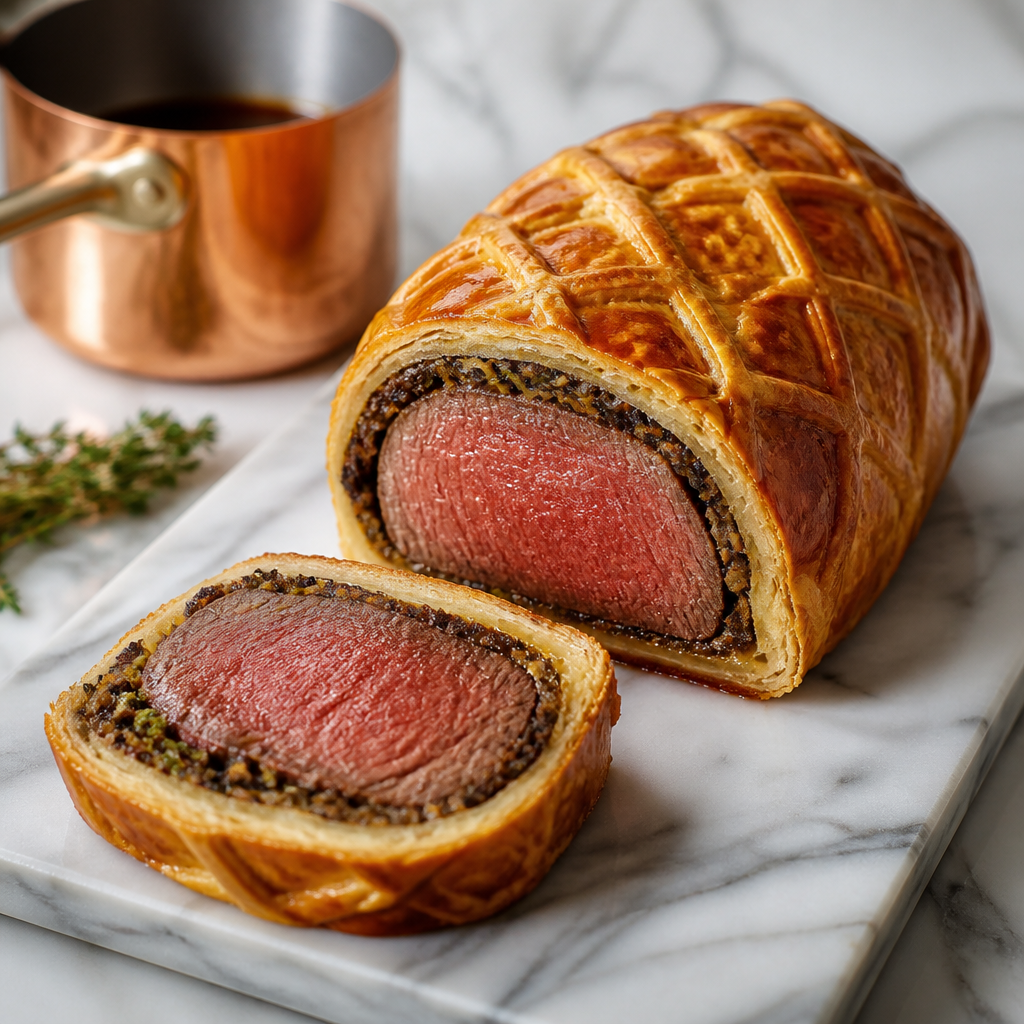
Few dishes announce an occasion quite like a Beef Wellington. Brought to the table whole, its pastry bronzed and crisp, it asks for a moment of attention before the first slice. Beneath that fragile shell sits rosy beef, framed by a dark, savoury mushroom layer. A glossy sauce on the plate completes the effect. It is generous without being casual, and technically exacting without needing to look fussy.
That combination explains its lasting appeal. Beef Wellington is at home at a Christmas table, in a classic dining room or as the centrepiece of a dinner for friends. Its history, however, is less neatly wrapped than its pastry.
A name linked to Wellington — but not proven
The dish is commonly attributed to Arthur Wellesley (1769–1852), the first Duke of Wellington, the British military commander and statesman who received the dukedom in 1814. Popular accounts suggest that the beef was made in his honour, perhaps after the Battle of Waterloo, or that it was a favourite of the Duke himself.
These stories are appealing, but the evidence is inconclusive. There is no definitive contemporary record showing that a cook created the dish for Wellesley, that he requested it, or that it was served at an event connected with him. The Duke’s name lends the dish ceremony and patriotic colour; it does not, on the available evidence, provide a documented origin story.
The chronology also invites caution. The Oxford English Dictionary records printed evidence for the term beef Wellington from the 1930s, long after the Duke’s death. That earliest cited use tells us when the name was in circulation in print, not when the preparation itself was first cooked. It does, however, make a direct Waterloo-era origin difficult to demonstrate. [^1]
A layered culinary family tree
Rather than looking for one clean moment of invention, it is more useful to see Beef Wellington as part of a family of beef-and-pastry preparations.
Britain had long known versions of fillet of beef cooked in pastry. Enclosing a roast in a crust protected it from fierce oven heat, helped retain juices and made an impressive presentation. Such dishes were not necessarily called Wellington, but they established a clear precedent for the format.
There are also close French comparisons. Filet de boeuf en croûte* means beef fillet in a crust, while *boeuf en croûte is a broader description for beef baked in pastry. Depending on the recipe, these may involve a whole fillet or another cut, different garnishes, and pastry that is not always the same as that used for a modern Wellington. They should be understood as related dishes, not as identical names for one fixed preparation.
The modern Beef Wellington generally brings together a particular set of elements: a centre-cut beef fillet, a concentrated mushroom mixture, puff pastry and, often, a barrier between the moist filling and the pastry. That combination may have developed through British and French culinary exchange, then acquired the Wellington name later. Food traditions frequently travel this way: techniques, ingredients and restaurant fashions cross borders long before a single title becomes familiar.
Why it feels so French
Beef Wellington can feel distinctly French because several of its most important techniques belong to the French classical repertoire.
The most recognisable is duxelles: finely chopped mushrooms cooked gently with aromatics, traditionally shallots, in butter until their moisture has evaporated and the mixture becomes deeply savoury and almost paste-like. Authoritative French culinary references define duxelles as a mushroom preparation reduced in this way, often used as a stuffing or garnish. [^2] In a Wellington, it supplies earthiness but, just as importantly, it must be dry enough not to soften the pastry.
Puff pastry is another crucial element. Its many thin layers of dough and butter separate in the oven, creating the crisp, airy case that makes the dish feel celebratory. Precise roasting, careful resting and a properly reduced pan sauce also reflect the discipline of French restaurant cooking. None of this makes the dish exclusively French. It simply shows how naturally the Wellington format draws on techniques that have been widely adopted in British kitchens and international dining rooms alike.
The anatomy of a Beef Wellington
A good Wellington is an exercise in balance. Every layer has a job to do.
The beef fillet is usually a trimmed centre-cut piece, chosen for its tenderness and even shape. It is seasoned and seared quickly in a very hot pan. The aim is not to cook it through, but to develop a browned exterior and a richer flavour before it finishes in the oven.
The duxelles sits around the beef as an intensely flavoured cushion. Mushrooms contain a great deal of water, so the mixture needs patient cooking. If it remains wet, steam will migrate into the pastry and compromise its crispness.
A protective layer often comes next. Some cooks use thin crêpes; others use prosciutto or another cured ham. This is optional, but practical: it creates a moisture barrier between the duxelles and pastry. It can also add salt and savoury depth. The choice reflects a cook’s preferred style rather than a single compulsory rule.
The puff pastry is the dramatic outer case. It seals in the filling, insulates the beef during its final cook and provides the contrast of crisp flakes against tender meat. An egg wash gives it a lacquered finish, while careful scoring can add a restrained decorative pattern.
The sauce should support rather than drown the Wellington. A reduced beef or veal jus, sometimes sharpened with wine or enriched with Madeira, brings moisture and depth to a plate where the pastry itself must remain dry.
What makes a great Beef Wellington?
The key is control of moisture and temperature.
First, cook the duxelles until genuinely dry. It should taste concentrated and look cohesive, not watery. Then cool it completely. Warm filling releases steam and softens the pastry before the Wellington even reaches the oven.
Chill each component thoroughly before wrapping. A cold, firm parcel is easier to shape, and cold pastry has a better chance of baking into distinct layers before the butter melts away. Wrap the filling snugly, seal the pastry well and place the seam underneath. Small gaps are invitations for juices to escape.
Temperature control matters as much as pastry work. The oven must be hot enough to set and colour the pastry, while the beef needs to remain tender at its centre. Because thickness, oven accuracy and starting temperature all vary, an instant-read thermometer is more dependable than timing alone. Finally, rest the Wellington before carving. This allows the juices to settle and gives the pastry a brief chance to stabilise, producing cleaner, more elegant slices.
A centrepiece that still evolves
Beef Wellington remains a fixture of festive menus because it turns skilled preparation into a shared moment. It has the polish associated with classic hotel dining, where a whole Wellington may be presented and carved tableside, but it also suits the modern home cook willing to prepare in stages.
Contemporary chefs continue to adapt it. Individual Wellingtons make portioning easier and shorten the theatrical pause at the table. Game can replace beef; vegetables can take the place of meat; and seasonal mushrooms can shift the character of the duxelles from delicate to boldly woodland-rich. These variations preserve the essential idea: a prized filling, carefully insulated and enclosed in crisp pastry.
Whether its name is British, its techniques French, or its lineage a little of both, Beef Wellington endures for a simpler reason. It rewards patience, precision and generosity. When the pastry crackles, the beef is properly rested and the first slice reveals its carefully made layers, it gives a table something worth gathering around.
Sources and notes
[^1]: Oxford English Dictionary, s.v. “beef Wellington,” historical citations. The OED’s earliest cited printed evidence is useful for dating the term’s documented use; it does not establish the date or place of invention.
[^2]: Larousse Gastronomique, s.v. “duxelles,” definition and classical use of the cooked mushroom preparation.
 14 September 2026
 9 September 2026