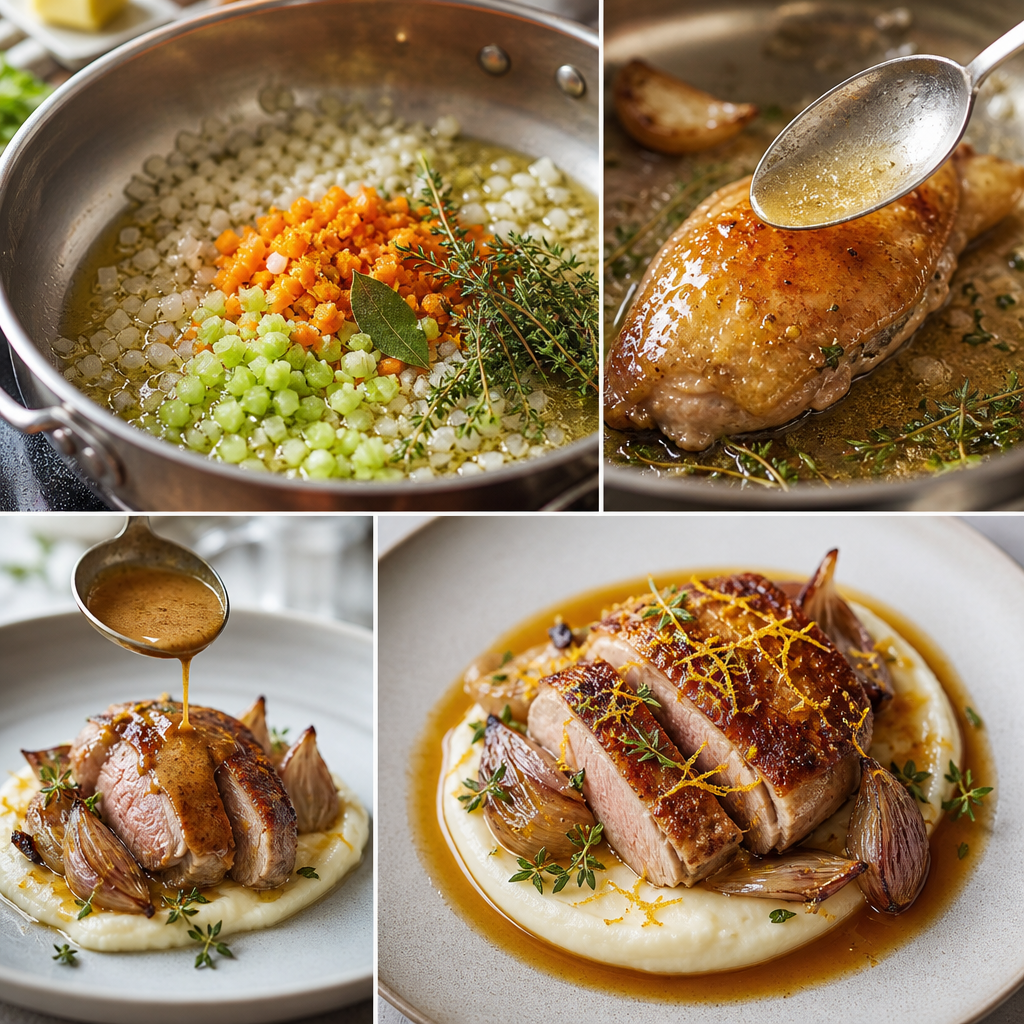
French flavour-building is a sequence of small, attentive choices: establish aromatics, brown with purpose, deglaze the fond, reduce wisely, then balance richness with salt, acid and fresh finishing touches.
The story
French cooking is often admired for its depth: a simple chicken, soup or plate of vegetables can taste more complete than its short ingredient list suggests. The useful lesson for home cooks is not that flavour requires elaborate recipes. It is that flavour is built deliberately, in small decisions made from the first chop to the final taste.
Flavour is built in stages, not added at the end
When cooks speak of a dish being “well seasoned”, they do not only mean salt sprinkled on at the table. They mean that flavour has been developed in stages. An onion has been given time to soften; mushrooms have been allowed to brown; the residue in the pan has been loosened into a sauce; a final squeeze of lemon has sharpened the whole dish.
A helpful sequence is foundation, concentration, balance and finish. Foundation comes from aromatics and cooking fat. Concentration comes from browning, stock and reduction. Balance comes from salt, fat and acid. The finish brings freshness, aroma and contrast.
Not every dish needs every step in equal measure. A delicate pea soup may rely on gentle sweating and a herb finish, while a beef braise needs serious browning and a long reduction. The point is to notice what each stage can contribute, rather than hoping one last ingredient will rescue a flat-tasting result.
Start with ingredients that have something to say
Technique can reveal the sweetness in a carrot or the savoury character of a chicken, but it cannot create flavour that was never there. Start with ingredients that are fresh, in season where possible, and stored well. A tomato that smells of little will not become vivid simply because it is dressed with excellent olive oil; tired herbs will not provide the same lift as leaves used soon after buying.
This does not mean every ingredient must be costly or rare. A modest cabbage, a bag of onions or a whole chicken can offer plenty when chosen carefully and cooked with attention. Store produce appropriately, use herbs before they wilt, and let ingredients with a short season take centre stage rather than burying them under too many additions.
French kitchens also tend to see useful flavour in parts often discarded. Clean onion ends, carrot peelings, celery leaves, mushroom stems and herb stalks can contribute to a stock. A Parmesan-style cheese rind can enrich a bean soup or broth. Bones and meat trimmings can add body when roasted and simmered for stock. Use only clean, sound trimmings, and choose them with the final dish in mind: a strongly flavoured cheese rind, for instance, is not right for every light soup.
Build a foundation with aromatics
Aromatic vegetables are the quiet beginning of many savoury dishes. The classic mirepoix is a mixture of onion, carrot and celery, cut to suit the cooking time. Its proportions vary with the recipe and the cook; it is a useful pattern, not a compulsory formula. Onion brings savoury sweetness, carrot adds sweetness and roundness, and celery contributes a grassy, lightly bitter note.
Often, the aim is to sweat these vegetables: cook them gently in butter, oil or another fat until softened and fragrant, without significant browning. A pinch of salt helps draw out moisture, and a lid slightly ajar can encourage tenderness. Sweated aromatics give a soup, risotto or braise a mellow base without announcing themselves.
At other times, browning is desirable. A darker, roasted stew or sauce may begin with onions or other vegetables cooked until golden. The choice depends on the result you want. Gentle heat preserves a cleaner, sweeter profile; higher heat creates deeper roasted notes.
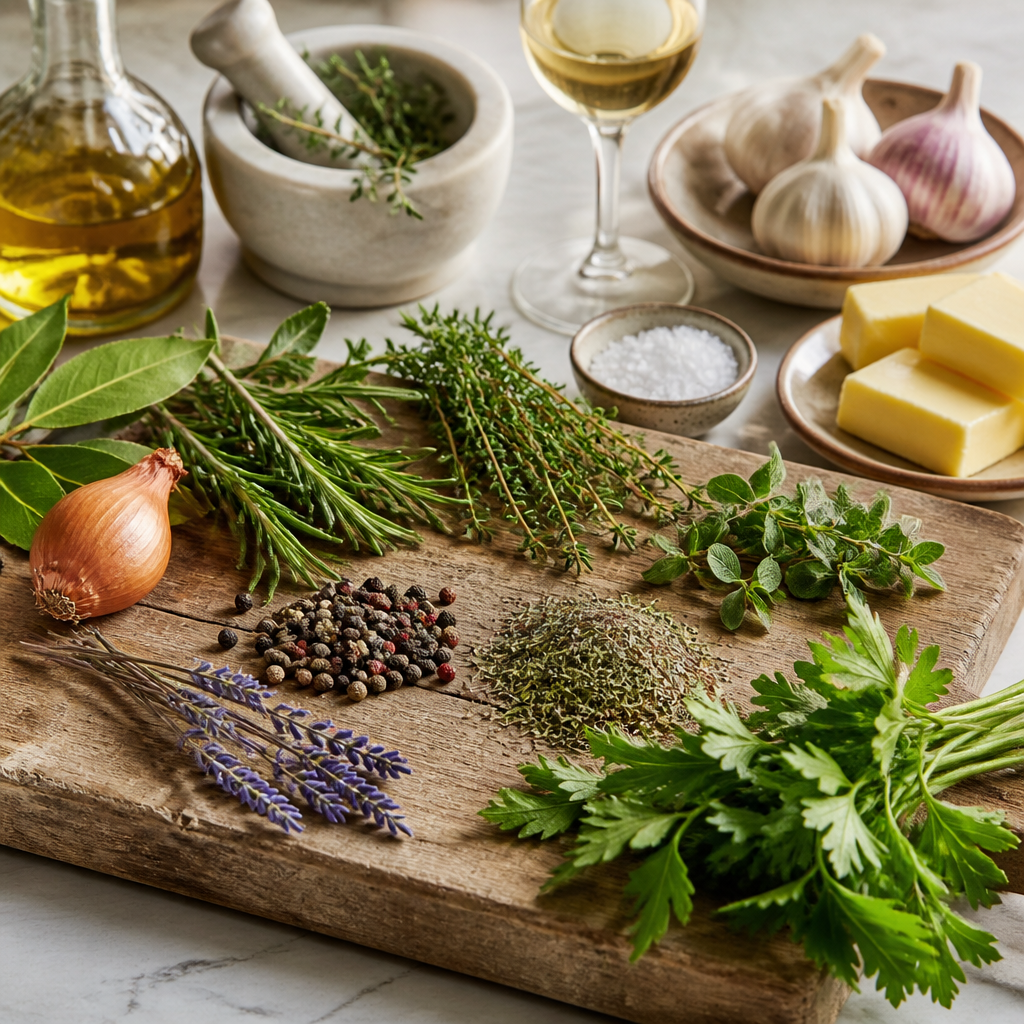
There is no single French foundation for every pan. Leeks are wonderful with fish, potatoes and cream. Shallots offer a finer, more delicate allium flavour in sauces and vinaigrettes. Garlic can be added briefly once other aromatics have softened, so it perfumes the fat without scorching. A bouquet garni—a small bundle of herbs, commonly including thyme, bay and parsley stems—can lend background fragrance to a simmering liquid and be removed before serving.
Use heat to unlock sweetness and savoury depth
Browning is one of the most valuable ways to build savoury flavour. When food is cooked at sufficiently high heat, amino acids and sugars react in a complex process known as the Maillard reaction. It produces many of the toasted, nutty, meaty aromas associated with a well-seared chop, roasted poultry, browned mushrooms or crusty bread.
This is related to, but not identical with, caramelisation. Caramelisation concerns sugars breaking down under heat and is especially evident in onions cooked slowly until deeply sweet and amber. In practice, both processes can contribute to a roasted flavour, but it is useful not to treat them as the same thing.
For good browning, dry food well, preheat the pan, and leave enough space for steam to escape. An overcrowded pan tends to steam ingredients instead of browning them. Cook in batches when necessary, particularly with mushrooms, diced meat or vegetables with a high water content. Resist moving food too soon: a chicken thigh or mushroom slice releases more readily when a crust has formed.
Colour is information. Pale food may need more time; blackened food has usually gone too far. Deep golden brown is flavour. Burnt garlic, bitter fond or scorched butter will carry harshness through a dish, and no amount of cream or salt can fully disguise it.
Capture the fond: deglazing is flavour recovery
After searing or roasting in a pan, you may see browned particles stuck to its base. This is fond, the flavourful residue left behind by cooking. It is not waste; it is an invitation to make a sauce.
Deglazing means adding liquid to a hot pan to loosen that fond. Wine, stock, water, cider, vinegar or a combination can work, depending on the dish. Add a modest splash, let it bubble, and scrape with a wooden spoon or spatula until the browned residue dissolves into the liquid. If the fond is black rather than brown, however, start again rather than incorporating bitterness.
For a quick chicken pan sauce, remove the cooked chicken to rest, pour off excess fat if needed, then add a splash of dry white wine or stock. Scrape the pan, reduce the liquid until it tastes more concentrated, and whisk in a small piece of cold butter off the heat. The result carries the flavour of the chicken into every spoonful. The same approach works after sautéing mushrooms: deglaze with stock, wine or a little water, then reduce until the pan is glossy rather than watery.
Stocks, reductions and sauces create concentration
Stock gives a dish a fuller starting point than plain water because it carries dissolved flavour and, when well made, some natural body. It need not be a restaurant project. A carefully chosen bought stock can be useful; a homemade vegetable, chicken or mushroom stock can add another layer when you have it.
Reduction is the act of simmering a liquid so water evaporates and its flavour becomes more concentrated. It is powerful, but it demands tasting. A sauce reduced by half may become wonderfully intense; pushed too far, it can turn salty, heavy or sharply acidic. If a reduction is becoming forceful, loosen it with a little stock, water or another appropriate liquid rather than pressing on.
Many satisfying sauces follow a simple logic: begin with a flavour base, add liquid, reduce to the desired intensity, enrich if appropriate, then season and adjust. The base might be shallots and fond; the liquid could be wine and stock; enrichment might be butter, crème fraîche or a little olive oil. This approach matters more at home than memorising a catalogue of classical sauces.
A good sauce supports its main ingredient. It should make roast fish taste more like roast fish, or give lentils and vegetables a coherent, savoury frame—not conceal everything beneath a uniform coating.
Balance salt, fat and acid with a chef’s discipline
Taste at more than one point. Seasoning early helps ingredients absorb flavour as they cook; tasting again before serving lets you correct the final balance. Salt is an enhancer: used with restraint, it can make sweetness, savouriness and aroma more apparent. It cannot replace depth, so add it in small increments rather than using it as a last-minute cure.
Fat carries flavour and softens rough edges. Butter can round out a reduced pan sauce; olive oil can give a vegetable soup a fragrant finish; crème fraîche can soften the edge of a mustardy sauce. Yet richness needs contrast. Acid—lemon juice, wine, vinegar, tomatoes or a cultured dairy product—makes a dish feel brighter and less heavy.
Think of familiar pairings: lemon with fish, Dijon mustard in a vinaigrette, or wine and vinegar in a braise. Add acidic ingredients gradually, especially after a sauce has reduced, because their effect becomes more pronounced as liquid evaporates. A few drops may be enough to wake up a stew that otherwise tastes dull.
Fresh herbs and finishing touches provide lift
Long-cooked flavours are comforting, but they can become enclosed. Finishing ingredients open them up. Freshly ground black pepper, lemon zest, chopped parsley, chives, a thread of good olive oil or a spoonful of crème fraîche can change the aroma of a dish just before it reaches the table.
Robust herbs such as thyme, rosemary and bay tolerate long cooking and are useful in stocks, braises and roasts. Delicate herbs such as parsley, chervil, basil, tarragon and chives are usually more vivid when added near the end. Toasted nuts can bring warmth and crunch; a few flakes of salt can provide a clean final spark. In a sauce, beurre monté simply means mounting with cold butter—whisking it in off the heat to make the liquid glossy and slightly fuller.
Use these touches to clarify the dish, not to decorate it indiscriminately. If the main flavour is sweet crab, let tarragon or lemon support it lightly. If a stew is already rich, choose parsley and vinegar over another buttery garnish.
Texture and contrast make flavour feel more vivid
Flavour is experienced through texture as well as taste. A smooth velouté feels more interesting with a crisp garnish of toasted breadcrumbs, nuts or fried herbs. A rich braise benefits from a sharp, lightly dressed salad. Creamy potato purée becomes more memorable beside crackling-skinned fish or roasted vegetables with browned edges.
Temperature can contribute too: a cool herb sauce with warm grilled meat, or chilled crème fraîche melting into hot soup. The contrast need not be dramatic. One crisp, sharp or fresh element is often enough to make a soft, rich dish feel more alive.
A practical French-chef checklist for every savoury dish
Before serving, run through this short sequence:
Choose ingredients with genuine flavour and use trimmings thoughtfully.
Establish a base with aromatics suited to the dish.
Control the heat: sweat for gentleness, brown for depth.
Capture browned residue with a well-chosen deglazing liquid.
Use stock, water or wine intelligently, and reduce only as far as the dish needs.
Taste and season in stages, not only at the end.
Balance richness with a measured touch of acid.
Finish with freshness, aroma and a useful textural contrast.
French flavour-building is less a secret repertoire than a habit of attention. Notice the scent of the aromatics, the colour at the bottom of the pan, the point at which a sauce becomes glossy, and the moment a squeeze of lemon makes everything clearer. Start with one practice—deglazing after searing, tasting earlier, or finishing a rich dish with acid—and repeat it until it becomes instinctive. That is how a home cook builds depth with calm, delicious precision.
 16 September 2026
 16 September 2026