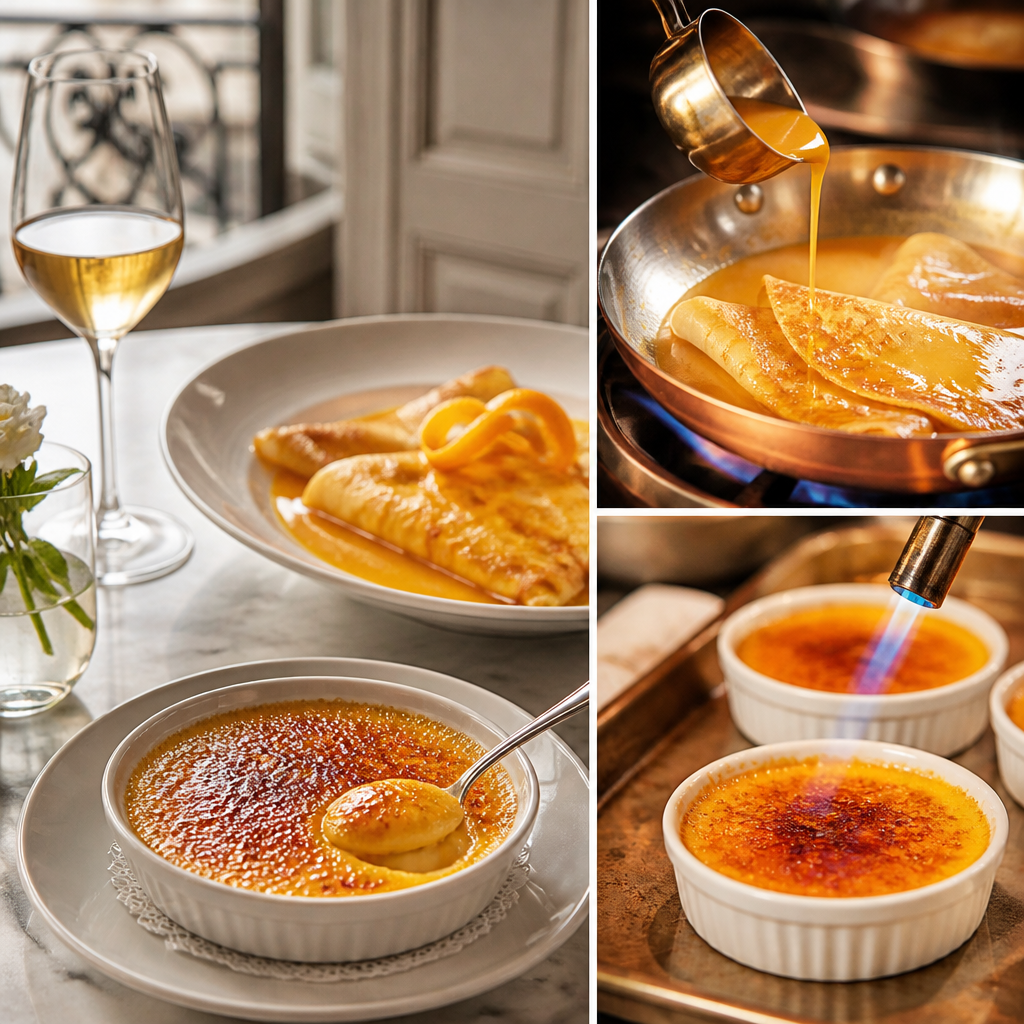
Crème brûlée and crêpe Suzette reveal the French dessert tradition at its most precise: a few ingredients, carefully balanced temperatures and confident restraint.
The story
Crème Brûlée, Crêpe Suzette and the Art of the French Dessert
French desserts are often recognised before they are fully understood. A brûlée arrives with its glassy lid of caramel; a Suzette fills the room with orange and warm butter. Both are familiar names, yet their appeal lies less in spectacle than in control: the right texture, the right temperature and a flavour that remains clear to the final spoonful.
The French dessert: a final course with its own language
In French cooking, dessert is not simply the sweet conclusion to a meal. At its best, it is a composed final course in which flavour, texture, temperature and appearance are kept in balance. Richness may be offset by fruit or bitterness; a soft cream may need a crisp element; a warm sauce may be paired with something cool. Even a modest dessert asks for a sense of proportion.
It is useful, too, to distinguish pâtisserie from dessert. Pâtisserie is the wider craft of pastry-making: cakes, tarts, choux buns, viennoiserie, confectionery and the techniques behind them. A restaurant dessert may draw on that craft, but it is designed for a particular moment in a meal. It must follow what has come before and leave the diner satisfied rather than overwhelmed.
The great French classics are therefore best understood as families of ideas, not fixed museum pieces. Recipes shift between regions, households and dining rooms. One cook may favour a deeper caramel, another a lighter cream; one restaurant may add a seasonal garnish where another serves the dish with almost austere simplicity. What matters is whether the defining character remains intact.
Crème brûlée—the elegance of contrast
Crème brûlée is a baked egg custard, usually flavoured with vanilla, served cold beneath a thin layer of caramelised sugar. Its pleasure rests on a small but decisive contrast: the spoon first breaks a brittle surface, then passes into a cool, smooth cream.
The custard itself is made by gently setting eggs with cream and sugar. The method matters more than complication. Too much heat, or too much time in the oven, can make the texture grainy, firm or eggy. A carefully baked custard should tremble slightly when it leaves the oven and finish setting as it cools. Chilling is not an afterthought: it gives the cream its settled, silky body and provides the temperature contrast that makes the caramel so effective.
The sugar should be caramelised immediately before serving, traditionally with a hot iron and now often with a small kitchen blowtorch. The aim is not a thick shell. It is a fine, even layer that melts, colours and hardens quickly without scorching. Caramel is a useful example of French dessert restraint: a little bitterness from browned sugar sharpens the sweetness of the custard; too much turns the dessert heavy and blunt.
When ordering or tasting crème brûlée, listen for a clean crack rather than a laborious smash. The caramel should be delicate, amber rather than blackened, and free from a sticky, under-melted centre. Beneath it, the custard ought to be creamy and cohesive—not loose and sloshing, but never rubbery or dense. Vanilla should perfume the cream rather than dominate it.
Its history deserves careful wording. France is closely associated with crème brûlée, but claims about a single, undisputed birthplace are difficult to sustain. Comparable preparations appear in several European culinary traditions, including English burnt cream and Catalan crema catalana, though these dishes differ in their customary flavourings, methods and service. Historical cookery books use related names and describe related custards, but a shared broad idea does not prove that every version is the same dessert. It is more accurate to say that crème brûlée belongs to a long European history of sweetened, egg-thickened creams finished with caramelised sugar.
Crêpe Suzette—the theatre of citrus and butter
Crêpe Suzette is a dish of fine crêpes warmed and coated in a sauce built around butter, sugar and orange. Orange juice and zest commonly bring freshness and fragrance, while orange liqueur is often used for depth; Grand Marnier and Curaçao are familiar choices in many modern restaurant versions. The finished crêpes may be folded, rolled or layered, depending on the cook and the style of service.
The dish works because its elements pull in different directions without falling apart. Butter brings roundness and, when allowed to brown lightly, a nutty note. Sugar contributes caramel character. Citrus cuts through the richness with acidity and perfume. The crêpe itself is soft and yielding, carrying the sauce without competing with it. Served warm, it feels generous but can remain surprisingly light when the sauce is balanced.
Flambéing is the most visible part of the dish’s restaurant reputation, but it is not its sole definition. Some versions are finished with flaming liqueur tableside; others are simply warmed in the orange-butter sauce. The flame can add aroma and drama, yet the essential achievement is the harmony of crêpe, caramel, butter and citrus—not the height of the fire.
The frequently repeated story that the dish was created for the Prince of Wales after an accident by a young waiter or chef, then named for a companion called Suzette, should be treated as an anecdote rather than settled history. It is often linked to Henri Charpentier and a late nineteenth-century visit to the Café de Paris in Monte Carlo, but accounts vary and have been repeated more confidently than they can be proven. The story endures because it suits the dish: theatrical, flattering and touched by chance. Its uncertain status need not diminish the pleasure of the crêpe itself.
What these two classics reveal about French dessert craft
Crème brûlée and crêpe Suzette rely on relatively few ingredients, which makes precision visible. There is nowhere for a poorly made custard to hide, and no elaborate garnish can rescue a sauce that is overly sweet or flat. Each dish depends on exact temperature, measured sweetness and clarity of flavour.
They also show two different ways of organising service. Crème brûlée is largely prepared in advance. The custard is baked and chilled, then finished à la minute—that is, at the last possible moment—when the sugar is caramelised. Crêpe Suzette is more active: crêpes are warmed, sauce is brought together, and the dish is served while its butter, citrus and heat are at their most vivid.
A classic, then, survives through faithful principles rather than rigid repetition. Vanilla may be replaced or complemented by coffee, citrus or a gentle spice in a brûlée, provided the cold custard and fine caramel contrast remain legible. A Suzette may use different orange expressions, a less sweet sauce or a discreet garnish, provided the central conversation between crêpe, butter, caramel and citrus is still clear. Innovation need not erase recognition.
How to order, taste or make them with confidence
In a restaurant, choose according to the finish you want from the meal. Crème brûlée is quiet, cool and spoonable: especially welcome after a meal that has already included several warm, sauced courses. Crêpe Suzette is livelier and more aromatic, with a warm sauce and a little ceremony. If flambéing is offered, regard it as a flourish rather than a test of quality.
For the home cook, both desserts reward simplification. Make a brûlée when there is time to chill the custard properly, and focus on a shallow, even caramel layer just before serving. For a Suzette, good shop-bought or home-made crêpes can be warmed in a carefully balanced orange-butter sauce; the important work is tasting for sweetness, acidity and richness as the sauce comes together. There is no need to attempt a tableside flame to understand the dish.
Coffee is a natural companion to crème brûlée, particularly when its slight bitterness echoes the caramel. Fragrant black tea or Earl Grey can work beautifully with either dessert, while a light dessert wine may suit an occasion where the meal calls for it. Often, though, the best pairing is restraint: let the final course finish the meal without adding unnecessary complexity.
French desserts can appear formal from a distance, yet their foundations are accessible. They ask not for extravagance but attention—to a custard’s set, an orange’s brightness, a spoon’s first crack through caramel. In crème brûlée and crêpe Suzette, that attention becomes the pleasure.
### A short glossary Custard: A mixture thickened chiefly by eggs, gently heated until it sets. >
Caramelisation: The browning of sugar through heat, producing deeper colour and complex toasted flavours. >
Flambéing: Briefly igniting alcohol in or over a dish, chiefly for aroma and presentation. >
À la minute: Prepared or completed at the last moment, immediately before service.
 9 September 2026
 8 September 2026