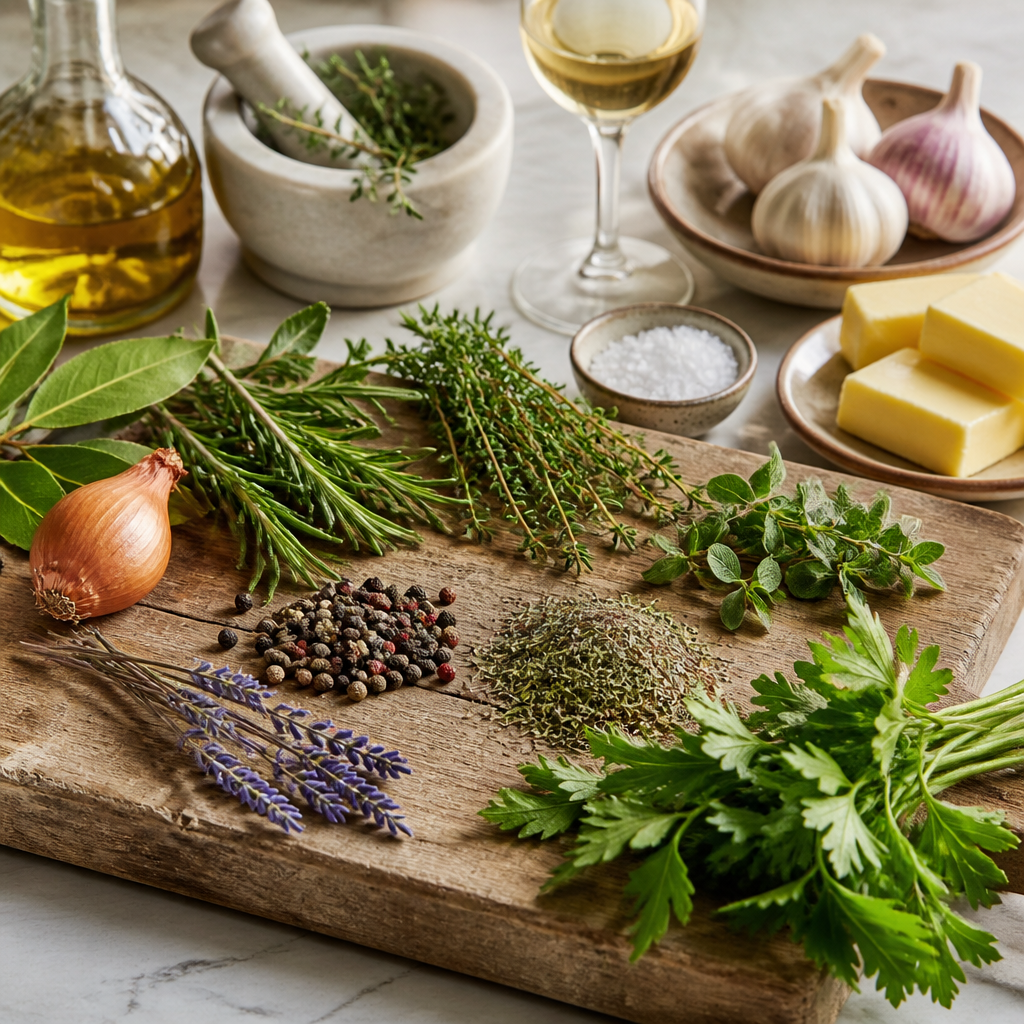
A practical guide to the French herbs, spices and aromatics that bring clarity and depth to everyday cooking—from thyme and tarragon to bouquet garni, nutmeg and piment d’Espelette.
The story
French cooking is often described as herb-forward, but its real strength is proportion. The goal is not to make a stew taste aggressively of thyme or a sauce of tarragon; it is to make chicken taste more chicken-like, tomatoes brighter, and a creamy sauce more complete. French herbs and spices work best when they support the ingredient at the center of the plate.
That principle also explains why there is no single French seasoning palette. Provence leans toward sun-loving herbs, garlic, fennel and olive oil; Alsatian cooking has room for juniper and warming spices; the Basque Country brings its own pepper tradition. Brittany, Burgundy and a Parisian bistro kitchen each have distinct habits as well. Learn a few core ingredients and, more importantly, when to use them.
The French approach to seasoning
It helps to separate four useful categories. Fresh herbs* bring vivid, green flavor and are often stirred in near the end. Dried herbs are more concentrated and particularly useful in soups, braises and roasts. Spice blends offer warmth and complexity, usually in small amounts. *Aromatic foundations—onion, leek, garlic, shallot and celery—build flavor from the beginning through patient cooking.
A practical rule: sturdy herbs can cook; delicate herbs should usually finish. Thyme and bay leaf welcome a long simmer, while chervil and chives lose their perfume quickly in high heat. Spices, too, need restraint. A pinch of nutmeg in béchamel should register as warmth, not announce itself.
Essential French herbs
Thyme
Woodsy, warm and lightly floral, thyme is one of the most useful herbs in a French-style kitchen. It suits stocks, braises, roast chicken, white beans, ratatouille, potatoes and mushrooms. Add a few fresh sprigs to a roasting pan, or use about 1/2 teaspoon dried thyme for a pot of soup serving four to six. Dried thyme holds up very well in long-cooked dishes; fresh thyme is especially good with roasted foods and as a final aromatic note.
Tarragon
Tarragon is green, gently sweet and distinctly anise-like. It is central to béarnaise and at home with chicken, eggs, fish, vinaigrettes and mustard-based sauces. Use it lightly: start with 1 tablespoon chopped fresh tarragon for a sauce or vinaigrette serving four, then taste. Its lively flavor is especially good against acidity and creamy textures—think vinegar, lemon, crème fraîche or butter.
Look for French tarragon when possible. It has the more refined culinary perfume associated with classic French cooking; Russian tarragon is generally milder and can be less expressive.
Parsley
Fresh, grassy and clean, parsley is the herb that restores balance to rich food. Use it in sauces, omelets, potatoes, seafood dishes and at the finish of a braise or sauté. Flat-leaf parsley is generally preferred for its fuller flavor and easy chopping, though curly parsley can still be useful as a garnish.
Parsley is also part of persillade, a chopped garlic-and-parsley preparation that can be scattered over sautéed mushrooms, roasted meats, snails or potatoes. Add it near the end so the garlic stays fragrant rather than harsh.
Chervil
Chervil is delicate: softly anise-like, with a gentle parsley note. It is lovely with eggs, spring vegetables, fish, salads and the classic fines herbes family of preparations. Stir it into a warm dish just before serving, rather than cooking it for long. Chervil is not simply a weaker parsley substitute; its faint sweetness and perfume are the point.
Chives
Chives bring a mild, clean onion flavor to omelets, vinaigrettes, crème fraîche sauces, potatoes and seafood. Snip rather than crush them, and add them at the end to preserve their color and fragrance. A tablespoon or two for four servings is usually enough to make their presence clear without turning a dish oniony.
Bay leaf
Bay leaf gives a subtle, herbal, tea-like and lightly floral background. It is a quiet but important element in bouquet garni, stocks, lentils, braises and sauces. Use one or two dried leaves in a medium pot, or a fresh leaf if available, then remove it before serving. Bay is not meant to dominate; it is there to make a liquid taste more settled and complete.
Rosemary, savory and marjoram
These herbs matter particularly in southern French and Provençal cooking, rather than defining French food everywhere. Rosemary is assertive and piney, excellent with lamb, potatoes and roasted vegetables. Savory has a peppery, savory edge that works beautifully with beans and meats. Marjoram is softer and slightly sweet, useful in Mediterranean-style vegetable, tomato and poultry dishes. With rosemary especially, a little goes a long way: one small sprig can season a tray of vegetables.
The classic French herb combinations
Bouquet garni
A bouquet garni is a bundle of herbs used to perfume stocks, soups, sauces and braises, then removed before serving. Its common core is thyme, bay leaf and parsley stems. Depending on the dish, it may also include leek green, celery, rosemary or tarragon. Tie the herbs with kitchen string, tuck them into a piece of leek leaf, or use a reusable infuser. There is no single mandatory formula; the point is gentle, removable background flavor.
Fines herbes
Fines herbes is the classic delicate mixture of parsley, chives, chervil and tarragon. The herbs are typically fresh, finely chopped and added late. Their fresh, light character makes them especially suited to eggs, fish, chicken, green vegetables and pale sauces. Try folding 1 to 2 tablespoons into an omelet just before it sets, or stirring them into softened butter for fish.
Herbes de Provence
Herbes de Provence is a modern culinary blend associated with southern France, not a fixed formula used identically across the country. Commercial blends vary, but commonly include thyme, rosemary, savory, oregano and marjoram. Some versions include fennel seed or lavender. Lavender is not mandatory, and it should be used cautiously: too much can make food taste perfumed rather than savory.
The blend became widely recognized through commercial seasoning mixes in the later 20th century, although its component herbs have long been used in southern French cookery. Use 1 to 2 teaspoons on a tray of vegetables, in a pot of beans, or as a rub for grilled meat. It is particularly good with tomatoes, eggplant, zucchini and chicken.
Spices and seasonings in the French pantry
Black pepper and white pepper
Black pepper is ideal for robust, rustic dishes and for finishing: steak, lentils, mushrooms and tomato-rich stews all welcome its bite. White pepper is often chosen for pale sauces, mashed potatoes, veloutés and some charcuterie preparations, where its color disappears into the dish. Freshly ground pepper has the clearest aroma; add some during cooking and, when appropriate, a final turn at the table.
Nutmeg
Nutmeg is a background warmth in béchamel, gratins, spinach, potato purée, quenelles and cream-based dishes. Grate it freshly if you can, but use just a few passes of the grater for a dish serving four. It should round out dairy and greens, never take over.
Clove and juniper
Clove is powerful, sweet-warm and useful in small quantities for pickling liquids, braises, charcuterie and certain meat dishes. Juniper berries bring a resinous, pine-like note and are particularly at home in Alsatian cooking, game dishes and preparations such as choucroute garnie. Lightly crush three to six juniper berries before adding them to a braise or cabbage dish; remove or avoid serving whole berries.
Quatre épices
Quatre épices is a traditional French warming spice blend used in pâtés, terrines, charcuterie and some long-cooked meat dishes. There is no definitive recipe. Many versions combine pepper, nutmeg and clove with ginger or cinnamon; proportions vary considerably. Buy a small jar or mix your own, then use it sparingly—often 1/4 teaspoon is enough for a terrine mixture or a pot of braised meat.
Saffron, fennel seed and piment d’Espelette
Saffron is important in Provençal and wider Mediterranean seafood cookery, including bouillabaisse. Because it is costly, treat it carefully: steep a small pinch of threads in a few tablespoons of warm stock or water for 10 to 15 minutes, then add both liquid and threads to the dish. This blooming step distributes its golden color and subtle hay-like, floral flavor more evenly.
Fennel seed has a natural affinity with southern French and Mediterranean flavors. Its sweet anise character works with fish, pork, vegetables and tomato-based dishes. Toast 1/2 teaspoon briefly in a dry pan, or crush it before adding to a sauce.
Piment d’Espelette is a Basque pepper with gentle warmth and a fruity character. The name Piment d'Espelette – Ezpeletako Biperra is protected by an Appellation d’Origine Protégée (AOP), which links qualifying production to its defined origin area and rules. It is not interchangeable with generic hot chili powder. Use it as a finishing seasoning over eggs, seafood or poultry, or in Basque-inspired sauces, starting with a small pinch.
French aromatics that matter as much as spices
Many French flavors begin not in a spice jar but in the pan. Garlic, shallots, onions, leeks and celery create sweetness, savor and depth when cooked patiently in butter, oil or rendered fat. A mirepoix—typically diced onion, carrot and celery cooked gently—is an aromatic preparation, not a spice blend. It can form the base of soups, sauces, braises and stews.
The lesson is useful for home cooks: if a dish tastes thin, more dried herbs may not be the answer. It may need onions cooked a little longer, a spoonful of stock, a touch of butter, or a final splash of wine vinegar or lemon.
How to use French herbs and spices with confidence
Keep these simple rules close:
Match sturdy herbs to long cooking: thyme, bay and rosemary can go in early.
Add delicate herbs late: chervil, chives and parsley retain more flavor when stirred in at the finish.
Bloom saffron and briefly toast or warm whole spices when appropriate; their flavor will spread more evenly.
Taste before adding more. Herbs concentrate as liquid reduces, and salt can make their flavor more apparent.
Balance seasoning with acid, salt, butter and stock rather than relying on ever-larger amounts of herbs.
For easy pairings, remember: tarragon with chicken, fish and eggs; thyme with beans, mushrooms and roasts; chervil with spring vegetables; nutmeg with cream and greens; and piment d’Espelette with eggs, seafood and poultry.
A compact French pantry to start with
A practical starter collection is thyme, bay leaves, flat-leaf parsley, tarragon, chives, black pepper, white pepper, nutmeg and herbes de Provence. Add one regional accent—piment d’Espelette or juniper berries—and you can cook a wide range of French-inspired dishes without an overcrowded cupboard.
Treat this as a flexible foundation, not a shopping mandate. Buy fresh herbs as you need them, keep dried herbs away from heat and light, and replace jars that have lost their aroma.
The most satisfying way to learn French herbs and spices is to use one clearly. Add thyme to a familiar roast chicken, tarragon to a simple vinaigrette, or nutmeg to your usual spinach. Notice what changes. With time, restraint becomes instinctive—and a small handful of seasonings becomes enough to make everyday cooking feel more precise, generous and distinctly French in spirit.
 16 September 2026
 15 September 2026