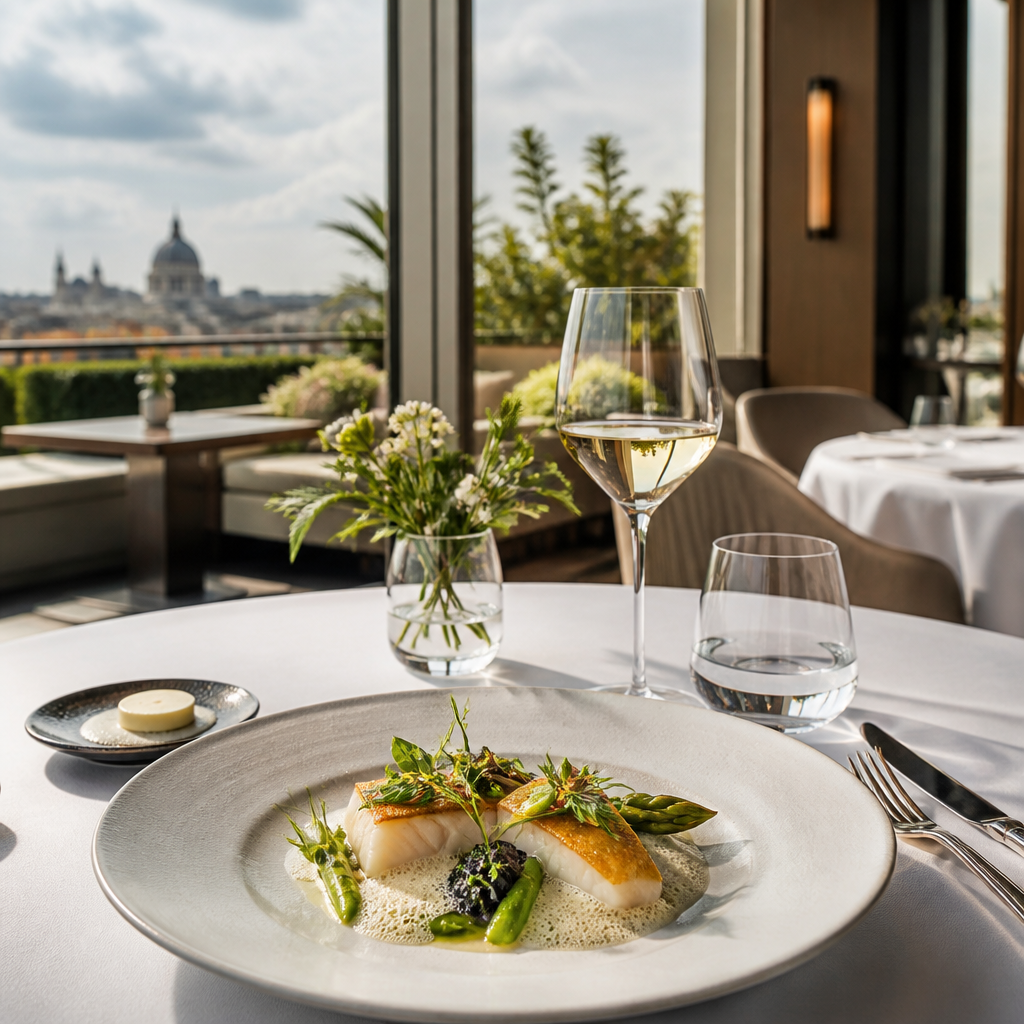
Fine dining is more than an expensive meal. Discover the combination of precise cooking, polished service, thoughtful atmosphere, and consistency that defines the experience.
The story
Fine dining, defined
Fine dining is an elevated restaurant experience in which ambitious cooking, thoughtful hospitality, a deliberate setting, and reliable attention to detail work together. It is not simply an expensive meal or a formal room; it is a coordinated standard that begins before the first course arrives and continues through the farewell.
The term is useful, but it is not a single legal or universally regulated designation. Consumer, licensing, and tourism classifications can vary by jurisdiction, while restaurants use the label in different ways. In practice, diners tend to recognize fine dining through the combined quality of the food, service, atmosphere, and operational consistency.
That definition leaves room for variety. A fine-dining restaurant may offer a long tasting menu, a concise à la carte menu, or something in between. It may be quietly traditional, brightly contemporary, rooted in local cooking, or inspired by several cuisines. The common thread is intention: the restaurant has considered how every part of the visit should feel and works hard to deliver it well.
The elements that distinguish a fine-dining restaurant
Ambitious, precise cooking
Fine dining usually begins with cooking that has a clear point of view. The kitchen may draw on classical technique, regional traditions, modern methods, or all three, but the food should feel purposeful rather than complicated for its own sake.
Precision shows up in seasoning, temperature, texture, timing, and presentation. A sauce supports rather than hides the central ingredient. Garnishes add flavor or contrast, not clutter. Courses follow a considered rhythm. The menu may change with the seasons or develop around a particular culinary idea.
Complexity is not automatically quality. A beautifully roasted fish with a well-made sauce can be as compelling as a highly technical composition. What matters is clarity, balance, and consistently sound execution.
Excellent ingredients and rigorous sourcing
Strong ingredients give a kitchen more to work with. Fine-dining restaurants often pay close attention to seasonality, freshness, origin, and how products are handled. Some build direct relationships with farmers, fishers, growers, cheesemakers, and other producers; others work with suppliers selected for dependable quality.
Provenance—the story of where an ingredient comes from—can be meaningful when it informs flavor, responsible purchasing, or the menu’s identity. Still, a costly ingredient does not make a restaurant fine dining by itself. Caviar, truffles, and premium cuts need thoughtful preparation, and humble ingredients can become memorable in skilled hands.
Service that is polished, warm, and knowledgeable
In fine dining, service is more than carrying plates. The team guides the experience: explaining a dish in plain language, answering questions, pacing courses appropriately, and helping guests choose wine or other beverages when asked.
Good service also includes practical care. Staff should be attentive to dietary requirements, alert to signals that a table needs something, and accurate about orders and bills. They may anticipate needs—refreshing water, replacing cutlery, or checking whether guests are ready for the next course—without hovering.
The best service feels natural rather than performative. It is knowledgeable without lecturing, formal only to the degree that suits the restaurant, and warm without becoming overly familiar.
A deliberate setting
The dining room matters because it shapes how easily guests can enjoy the meal. Fine dining commonly involves careful choices around lighting, seating comfort, table spacing, tableware, acoustics, cleanliness, and design. A room need not be grand to be considered: it may be spare and modern, lively and open, or small and intimate.
Traditional signals such as pressed linens and formal place settings can suit some restaurants, but they are not requirements. Contemporary fine dining can feel relaxed, personal, and even playful. The important question is whether the setting supports the food and hospitality rather than distracting from them.
Consistency and attention to detail
A fine-dining standard is difficult to sustain because it must extend beyond a single impressive plate. It can be seen in a clear reservation process, a timely greeting, accurate information about the menu, clean restrooms, well-timed courses, and a graceful goodbye.
Consistency does not mean every meal is identical. Menus evolve, ingredients vary naturally, and individual guests have different needs. It means the restaurant has systems, training, and care that make excellent execution dependable across services and visits.
What fine dining is not
Fine dining is not defined by price alone. A high bill can reflect costly ingredients or a desirable location, but it does not guarantee thoughtful cooking, capable service, or genuine hospitality. Conversely, a refined restaurant may choose an approachable format, modest décor, or a shorter menu.
Nor do white tablecloths, dress codes, tasting menus, celebrity chefs, jackets, sommeliers, or prix fixe menus automatically settle the question. These features can be associated with fine dining, but none is mandatory.
Michelin recognition is similarly related but not synonymous. Michelin Stars are awarded for the cooking, with its published criteria focused on factors such as product quality, mastery of technique, harmony of flavors, the chef’s personality in the cuisine, and consistency. A Star is not a rating of service, décor, or formality, even though a restaurant’s overall experience may be recognized through other Michelin distinctions or guide information.
Fine dining versus upscale casual and casual dining
These categories overlap, and local expectations vary. A restaurant in one city may be described differently in another. Still, the following comparison offers a useful starting point.
| Feature | Fine dining | Upscale casual | Casual dining |
|---|---|---|---|
| Menu | Often highly developed, seasonal, and course-driven; à la carte or tasting formats | Polished, ingredient-led dishes with broad choice | Familiar, straightforward dishes and flexible choice |
| Service | Detailed guidance and closely managed pacing | Attentive but generally less formal | Efficient, friendly, and direct |
| Atmosphere | Carefully composed, with comfort and detail central | Stylish and relaxed | Informal and practical |
| Pacing | Meal may be leisurely, especially for tasting menus | Moderate | Usually quicker and more flexible |
| Price expectation | Typically higher, reflecting labor, ingredients, and service | Mid-to-high, depending on market | Usually lower to mid-range |
| Reservations and dress | Reservations are often advisable; guidance may be stated | Reservations may be useful; smart casual is common in many places | Walk-ins are often easier; dress is usually relaxed |
A restaurant can move between these descriptions depending on the daypart, menu, or location. Use the venue’s own information rather than relying only on a category label.
What to expect as a guest
Fine dining should invite curiosity, not anxiety. Before booking, look at the restaurant’s website or booking page for the current menu, service style, dress guidance, reservation deposit, and cancellation policy. These details differ by venue and can change, so the restaurant is the best source.
Allow enough time for the meal. A tasting menu, in particular, is designed around a set sequence and pace; it may not suit a tight schedule. If you have allergies or dietary restrictions, tell the restaurant when booking and confirm any needs in advance rather than assuming changes can be made at the table.
Ask questions freely. It is entirely reasonable to ask how a dish is prepared, whether a menu can be adjusted, what a beverage pairing involves, or how large portions are likely to be. A capable team will help you navigate the meal without making you feel tested.
Gratuity practices also vary by country and venue. Check the bill for an included service charge and follow local norms if you are unsure; staff can usually clarify the restaurant’s policy.
Is fine dining worth it?
Value is personal. For some diners, a fine-dining meal is ideal for a celebration, a special trip, or an evening centered on food. For others, the same budget may be better spent on several simpler meals. Neither choice is more correct.
What guests may be paying for is not only the food on the plate, but also culinary skill, carefully sourced ingredients, staffing, training, preparation time, tableware, atmosphere, and the coordination required to make the evening flow. Whether that feels worthwhile depends on the restaurant’s style, your expectations, and the occasion.
Fine dining, at its best, is elevated hospitality delivered with skill, intention, and consistency. It does not require a rigid script or a particular kind of dining room. Choose the restaurant whose menu, mood, and degree of formality feel right for you, and let the label be a guide rather than a barrier.
 9 September 2026
 8 September 2026